Culture+

Culture Plus Executive Papers · No. 01

The Psychosocial Safety Blueprint™

An executive operating model for psychosocial hazard management and psychosocial risk management in Australia. Written for boards, CEOs, officers and executive teams accountable under WHS legislation.

Free executive white paper · PDF · July 2026 edition · General information, not legal advice

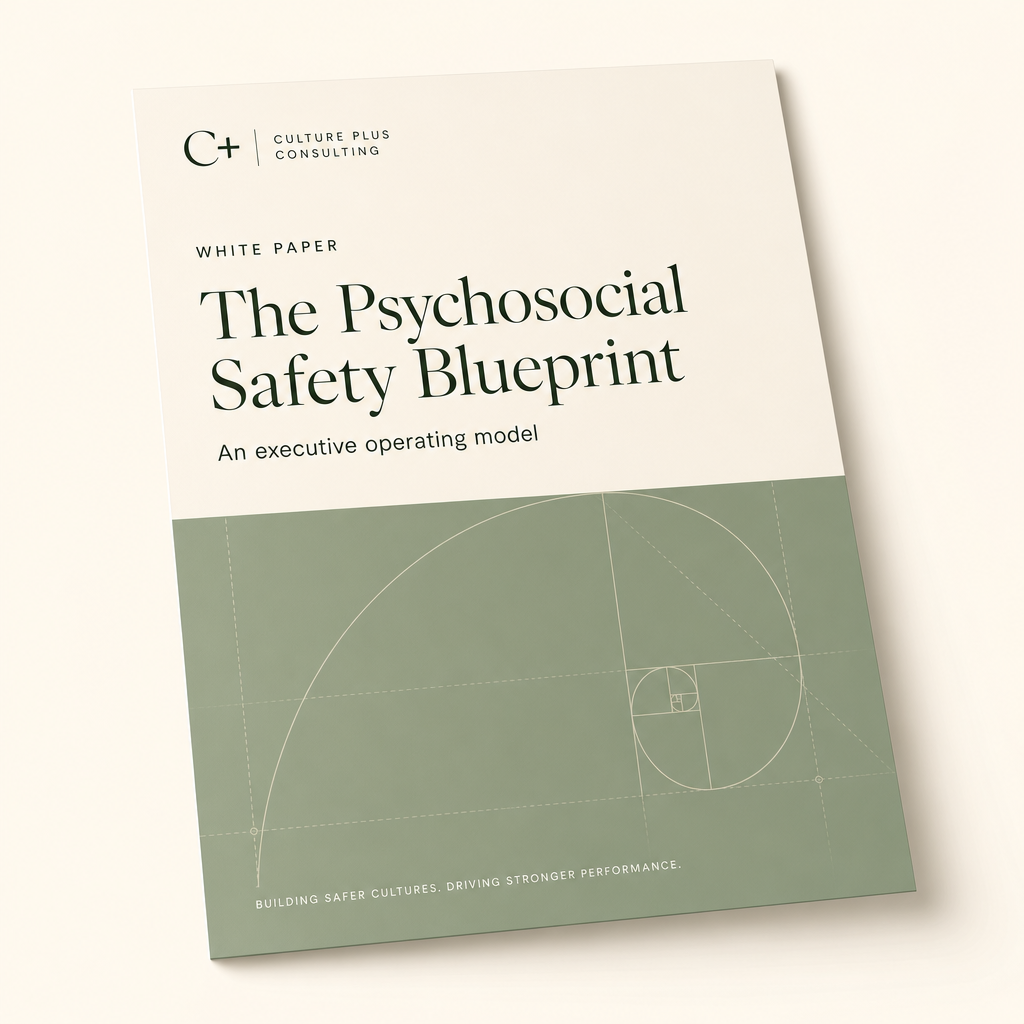
The Psychosocial Safety Blueprint white paper cover — executive guide to psychosocial hazard and risk management in Australia

Why it matters

The gap between the psychosocial safety duty and the operating model to meet it.

Serious psychological injury claims in Australia have risen 161 per cent in a decade — the largest increase of any injury category. The mental health cost to the national economy is estimated at up to $39 billion a year.

Regulators have moved. Model WHS Regulations, ISO 45003, the SafeWork NSW Code and Comcare's compliance program all now expect psychosocial hazards to be managed at the source — with officers personally on the hook.

Most organisations have not moved with them. Accountability sits at the executive level; the response sits with wellbeing and training. The Blueprint closes that gap.

161%

Increase in serious psychological injury claims over the decade to 2023–24

$39B

Annual national cost of mental ill-health in lost participation and productivity

6 Pillars

Executive operating model spanning Governance to Employee Experience

6 Practical Tools

Maturity assessment, implementation pathway, decision lens, diagnostic questions, board challenge set and worked examples

What's inside

A complete executive operating model for psychosocial safety.

Three parts. Nineteen chapters. Six executive practical tools. Written as a governance-grade operating model that can be defended to a board, a regulator and the workforce — not a checklist and not a wellbeing programme.

Part I

The Governance Challenge

Reframes psychosocial safety from a wellbeing programme to a director-level governance obligation — and shows why the current corporate response is legally and financially exposed.

  • The leadership gap and the cost of inaction

    Why executive teams are underwriting a risk they don't yet govern — the claims curve, the productivity drag and the reputational tail.

  • The return on prevention

    The evidence base for prevention-at-source economics — including the multiplier on every dollar shifted from response to design.

  • Recent regulatory signals and prosecutions

    What SafeWork, Comcare and state regulators are actually enforcing — with the decisions, penalties and undertakings executives should know by name.

  • The physical–psychosocial safety link

    Why psychosocial hazards cause physical injury (and vice versa) — and what that means for integrated WHS reporting.

  • Officer due diligence in practice

    The six statutory limbs of officer due diligence, translated into board and executive behaviours that would survive a regulator interview.

  • The global landscape — ISO 45003, ESRS S1 and market expectations

    How international standards, disclosure regimes and investor expectations are converging — and where Australian boards are already behind.

  • From activities to systems

    Why training rosters, EAP uptake and pulse scores are not evidence of control — and what a system-level response looks like.

Part II

The Blueprint

The operating model itself — six pillars, six executive practical tools and a spotlight chapter on the next frontier of psychosocial risk.

  • Design philosophy and foundational principles

    The seven principles that separate a defensible operating model from a wellbeing programme in a governance wrapper.

  • The research foundation

    The organisational psychology, WHS science and governance research underpinning every element of the model.

  • The Six Pillars™

    Governance, Organisational Design, Work Systems, Leadership, Assurance and Employee Experience — each pillar defined, staffed and measured.

  • The Executive Maturity Assessment™

    A structured self-assessment across all six pillars — outputs a maturity heatmap boards and audit committees can act on.

  • The Implementation Pathway™

    A staged roadmap from foundation to embedded practice — foundations in 90 days, core operating model within 12 months, full embed at organisational scale — with owners, artefacts and evidence at each gate.

  • The Executive Decision Lens™

    A one-page practical tool for testing restructures, tech deployments, resourcing calls and performance changes for psychosocial risk before approval.

  • Spotlight — AI and digital work systems

    How algorithmic management, surveillance and generative AI are creating a new class of psychosocial hazard — and how to govern it now.

Part III

Putting It To Work

How to operationalise the Blueprint inside real executive rhythms — board papers, committee cadences, decision gates and the questions that force the system to work.

  • From operating model to executive practice

    How the Blueprint plugs into existing risk, audit, people and strategy cycles — without creating a parallel governance stack.

  • The outcomes of executive governance

    The signals that tell you the operating model is working — lead indicators, lag indicators and the evidence a regulator will look for.

  • Ten questions every leadership team should ask

    A meeting-ready diagnostic to pressure-test whether current controls would hold under scrutiny.

  • Five questions for the board and committees

    A director-level challenge set — designed to be tabled at the next Audit, Risk or People Committee.

  • Governance in practice — worked examples

    Anonymised case constructions showing the Blueprint applied to a restructure, a technology rollout and a serious incident response.

Executive practical tools included

Six executive practical tools your board can use immediately.

Every executive practical tool in the Blueprint is included in full. Each is designed to be lifted straight into board packs, committee agendas and executive decision-making.

01

The Executive Maturity Assessment™

A structured board-ready self-assessment across the Six Pillars. Produces a maturity heatmap, a gap register and a prioritised set of executive actions — the artefact your Audit or Risk Committee can table at the next meeting.

Use it to answer: where would we fail a regulator today?

02

The Implementation Pathway™

A staged roadmap moving the organisation from foundation to embedded practice — foundations in 90 days, core operating model within 12 months, full embed scaled to organisational size and risk profile. Each stage names owners, artefacts, decision gates and the evidence required. Designed to plug into existing strategy and risk cycles rather than create a parallel programme.

Use it to answer: what do we do first, who owns it, and how do we know it worked?

03

The Executive Decision Lens™

A one-page practical tool for pressure-testing material decisions — restructures, resourcing calls, technology deployments, performance framework changes — for psychosocial risk before they are approved. Creates an auditable record of officer due diligence.

Use it to answer: would this decision survive scrutiny after an incident?

04

The Executive Team Question Set — Ten Questions

A meeting-ready challenge set designed to be tabled at an executive leadership meeting. Pressure-tests whether current controls, accountabilities and evidence would hold under regulator or media scrutiny.

Use it to answer: do our current controls pass the common-sense test?

05

The Board & Committee Challenge Set — Five Questions

A director-level diagnostic written for Audit, Risk and People Committees. Helps boards test whether they are receiving the right information, at the right level, with the right evidence of officer due diligence.

Use it to answer: what should the board be asking at the next committee?

06

Worked Examples & Case Constructions

Anonymised case constructions showing the Blueprint applied to a restructure, a technology rollout and a serious incident response. Each example includes the decision, the risk analysis, the controls applied and the evidence trail.

Use it to answer: what does this actually look like in our context?

The Six Pillars™

The systems executives must govern.

01

Governance

Board and executive accountability, risk appetite, register placement and reporting.

02

Organisational Design

Role clarity, spans of control and restructures assessed for psychosocial impact before approval.

03

Work Systems

Workload, resourcing, performance frameworks and technology deployment governed at the source.

04

Leadership

Officer due diligence, leader capability and manager conduct benchmarked to WHS duties.

05

Assurance

Independent verification, psychosocial risk data and audit that executives actually see.

06

Employee Experience

Reporting pathways, response quality, restoration and lived experience of safety.

What you walk away with

Eight things you can put to work immediately.

  • A defensible executive answer to the question: how do we govern psychosocial risk at the source?
  • Language and framing that moves psychosocial safety out of wellbeing and into risk, audit and governance.
  • A maturity read across the Six Pillars — so the board knows where the organisation is exposed today.
  • A staged implementation pathway — foundations in 90 days, core operating model within 12 months — that fits inside existing strategy, risk and people cycles.
  • A one-page decision lens that creates auditable evidence of officer due diligence on material decisions.
  • A meeting-ready diagnostic set — ten questions for the executive team, five for the board.
  • Worked examples showing the model applied to restructures, technology rollouts and incident response.
  • A reference framework aligned to model WHS Regulations, ISO 45003, ESRS S1 and current regulator expectations.

Reform-grade Respect at Work, delivered at the heart of government.

Trusted at the highest level.

NSW Parliament

Culture Plus Consulting was engaged by NSW Parliament to design and deliver Respect at Work and Trauma Informed Response training across its workforce — a flagship reform initiative responding to the Broderick Review of bullying, sexual harassment and sexual misconduct in NSW parliamentary workplaces. This engagement represents a proud achievement in delivering reform-grade Respect at Work training in high-scrutiny environments.

Parliament of New South Wales

NSW Premier's Department

In an ongoing engagement, Culture Plus Consulting delivers Respect at Work training to the Premier, Ministers and Ministerial staff — a key recommendation of the Goward Review aimed at building respectful, safe and accountable workplaces at the heart of government.

Premier's Department NSW

Written for

Executives accountable for the systems that determine psychosocial safety.

  • Boards, Chairs and Board Committees (Audit, Risk, People)
  • Chief Executives and Executive Leadership Teams
  • Officers with statutory due diligence duties under WHS legislation
  • Chief People Officers, Chief Risk Officers, General Counsel and Company Secretaries
  • Governance, Audit, Risk and Assurance leaders
  • Business unit executives with accountability for organisational design
Download The Psychosocial Safety Blueprint — executive white paper on psychosocial hazard and risk management

Free executive white paper

Download the white paper.

Enter your details to receive the full paper — including the Six Pillars™, the Executive Maturity Assessment™, the Implementation Pathway™, the Executive Decision Lens™, the executive and board challenge sets, and worked examples.

Complete the form to access your copy.

Executive advisory only. Not legal advice.

General information only — not legal advice. See full disclaimer.

Related services

Put the Blueprint into practice.

Psychosocial Hazards Consulting & Risk Assessment

Independent advisory to identify, assess and control psychosocial hazards at the source under WHS legislation and ISO 45003.

Advisory & risk assessment

Psychosocial Hazards Training for Leaders

Officer and manager capability to meet due diligence duties and lead safely under model WHS Regulations.

Leadership training

Psychological Safety Training for Teams

Team-level conditions that prevent psychological harm and enable respectful, high-performing work.

Team training

Respect at Work for Executives & Boards

Governance-level capability for officers on Positive Duty, psychosocial risk and personal accountability.

Executive & board

Positive Duty Compliance Advisory

End-to-end readiness for the AHRC Positive Duty and its intersection with psychosocial safety duties.

Positive Duty

Board Leadership & Governance

Culture, psychosocial risk and officer due diligence briefings for boards and committees.

Board leadership

Case studies

Governance in practice.

See how executive teams have used the same operating principles to govern psychosocial risk under WHS legislation and the Positive Duty.

Trusted partners

Executive advisory outcomes.

"
Felicity has been a trusted partner to our business over a number of years. What really sets her apart is the effort she puts into understanding our culture and how we operate. This understanding comes through clearly in her sessions, making them highly relevant and practical for our team. Her training is consistently engaging, thoughtful and well-delivered, and we continue to receive excellent feedback from participants. The impact is evident in both the quality of the discussions during sessions and how the content is applied afterwards. We look forward to continuing our partnership.
Executive Director, Head of People & Culture
Financial Services · identity withheld
1 / 3

Frequently asked

Psychosocial safety, hazards and risk — clarified.

What is psychosocial safety?

+

Psychosocial safety is the state in which the systems that determine work — how it is designed, resourced, led and governed — do not create foreseeable risk of psychological harm. Under Australian WHS legislation, PCBUs must eliminate or minimise psychosocial hazards so far as is reasonably practicable, at the source.

What is psychosocial hazard management?

+

Psychosocial hazard management is the systematic identification, assessment, control and review of workplace hazards that can cause psychological harm — including chronic workload, role conflict, poor change management, unfair performance systems, bullying, harassment and traumatic content exposure.

What is psychosocial risk management?

+

Psychosocial risk management is the executive governance of the decisions that create psychosocial risk — resourcing, restructures, technology deployment, role design and performance frameworks — assessed and controlled before harm occurs. It sits with officers, not with wellbeing programs.

How does the Blueprint help me meet officer due diligence?

+

The Blueprint gives officers a defensible operating model: named accountability, decision-lens assessments before material decisions, psychosocial risk on the enterprise register, and reporting that shows whether the systems generating risk are changing.

Disclaimer

The Psychosocial Safety Blueprint™ and this webpage are published by Culture Plus Consulting for general educational and governance purposes only. They do not constitute legal, medical, financial or other professional advice, do not create a consultant–client or lawyer–client relationship, and should not be relied on as a substitute for advice from qualified professionals in your jurisdiction. Regulatory obligations under Australian WHS legislation, ISO standards and related frameworks vary by state, industry and circumstance. Obtain your own advice before acting. Case examples referenced are illustrative constructions, not statements about identifiable organisations or individuals.